grieving with peace

Rejoice with those who rejoice, and weep with those who weep.

Romans 12:15

Through my 25 years of being a Christian, truly surrendered to Jesus Christ as my Lord and Savior, life has not been a bowl of cherries. There’s been personal loss, betrayal, death, illness—you know, the general brokenness of this fallen world crashing down…just like everyone else. And just like before I was a believer. The difference, however, has been in my response to these situations because of the eternal perspective of God’s providence. 

The lens of faith colors every challenge and tragedy (and victory) a bit differently for believers than the view the world sees in these same circumstances. And that can completely bewilder those around us. Sometimes, it even confounds us.

I recently witnessed this truth in a fresh way, as the body of Christ (the Church) demonstrated the love of Jesus—and God’s promises for Christian life came to fruition. A family in my church small group experienced the devastating loss of a child. From the moment our group learned of this, we rallied. We prayed, we texted love and support. One couple immediately went to the hospital to listen, talk, and pray with the family. The next days, more of us, throughout the hospital stay, visited to be present, provide lighthearted distraction, and offer up more prayer. Once home, our group brought meals daily, again visiting with listening ears and gentle kindness. God’s love in action. Biblical living. We are called to weep with those who weep…and we did.

And as this sweet family continued to grieve, they spoke of the unreasonable and inexplicable peace they were experiencing amid their sorrow. God’s Word calls this “peace that passes understanding” (Philippians 6-7)—and it is His promise to us. 

This is not about tossing pillow-stitched verses at someone experiencing loss or difficulties. It’s not even about “saying the right thing”. It is about coming around that person or family with love and prayer and a listening ear—not a talking mouth. It’s about knowing the truth: that we, as believers, don’t grieve like the rest of mankind who have no hope—we have confidence that through the death and resurrection of Jesus, we will see our loved ones in Christ again (1 Thessalonians 4:13-14). We hold fast to that eternal perspective. And although there will be times to weep and mourn throughout life (Ecclesiastes 3), God and His people can alter those experiences. There will still be pain, but it’s bathed in something heavenly. It’s altered by the peace of God.

Heavenly Father, living in this fallen world can be so painful. But You have made promises to those who love You—promises for peace and joy that surpass understanding. Thank you for revealing Your love and truth through the body of Christ in this world.

wash your face.

So David got up from the ground, washed, anointed himself, and changed his clothes; and he went into the house of the Lord and worshiped. 

2 Samuel 12:20

I don’t know about you, but sometimes I get into these funks of “if only” and “I wish I would have…”. Most recently, for me, it was around Mother’s Day when I considered both my own mother and my mothering. I imagine that every parent reading this thinks about these things occasionally, especially if your kids are teens, young adults, or older. Maybe we look at how a child is living and the choices they’re making and wonder, “If I’d only done ___________ when he/she was younger…” or “Maybe if I decided to do X instead of Y, things would be different for them.” Or, if you’re like me and have lost one or both parents, it’s easy to list the regrets of how you treated them, or things said—even rehearsing those terrible teen/20s attitudes and interactions with them that shaped years (or decades) of relationship. Oh, to relive those yesterdays with the wisdom and understanding of today. (Or is that just me?)

But friend, we simply cannot. (First, though, let me remind us all that we did the best we could with what we knew—and who we were—at those times we’re looking back to.) We can’t go back and change our decisions to shift trajectories. Plus, we don’t have any clue about whether that revised trajectory would be better or worse! And we certainly can’t change the words and actions of other people, which ultimately set the path for their lives.

As I was meandering through Regretville, I got to 2 Samuel, chapter 12, where the prophet Nathan rebukes David for his sin against the Lord. (I suggest you go back and also read chapter 11—it’s got all the elements of today’s Netflix hits: adultery, deception, murder…). But it was only when Nathan confronted David that David’s eyes were opened to everything he’d done. The man truly had a lot to regret. And although David was “a man after God’s own heart”, a valiant warrior for the Lord, the king of God’s people, and the ancestor of the Greater David to come, Jesus, there were consequences for his grave sin. Sadly, despite David’s fasting, weeping, and praying, the child he conceived in adultery became sick and died. Then came another fascinating part of this event: David got up, washed, put on fresh clothes, and worshipped the Lord (v19-20). He understood the sovereignty of God. While the child was still alive, David prayed for what he wanted the outcome to be. But when God’s outcome came to pass (a painful, horrible outcome in David’s—and our—opinion), David worshipped the Lord for His providence. Moreover, David’s theology was rock solid, knowing that he would see his child again in heaven—what a profoundly encouraging Biblical truth for us. David turned from the “what ifs” and grabbed hold of his now, determined to be more focused on the Lord. 

A few days after I read through these Biblical events, I came across this quote from John Piper that beautifully summed up these Old Testament chapters, along with putting a pin in my own mental road trip: “Occasionally, weep deeply over the life you hoped would be. Grieve the losses. Then wash your face. Trust God. And embrace the life you have.” 

We all are in different seasons of our life—and, for believers, we’re in different sanctification places. Right now, it could be smooth sailing. But maybe it’s rough waters…or even the storm of storms that’s beating you senseless. Wherever we are, GOD IS SOVEREIGN. He’s got you—and me. We pray (and plead), and we trust, knowing that He “causes all things to work together for good to those who love God, to those who are called according to His purpose” (Romans 8:28). And He intends for good even things and people of this world intending evil (Genesis 50:20). Note here, God doesn’t “use” or “turn” evil situations to good—like, “Oops, I wasn’t expecting that, but I can turn that around.” No, these situations are all in His hands, from the beginning, for His glory. We may be able to look back in time and see that…or we may have to wait until we’re in heaven and look back through eternity to understand. Either way, it’s OK. We are in His hands.

Lord, as we continue to walk through this dark world—yesterday, today, and tomorrow—remind us to keep our eyes on You, trusting You to bring about our good and Your glory.

foolish friends

“He who walks with the wise grows wise, but a companion of fools suffers harm.”

Proverbs 13:20

Proverbs 13:20 was one of the very first lines of scripture that I memorized as a new believer—and it sets a great foundational direction for all of us who desire to follow Christ. Typically, we think to ourselves, “Yes, this is exactly what our kids need to know!” It definitely is. But this verse is also one of the many pieces of wise Biblical direction we give our kids that, sadly, they don’t necessarily follow. And, unfortunately, the second part of the Proverb—as promised—comes to pass. We simply keep praying that they’ll learn.

Let’s turn the mirror on ourselves for a minute. Sure, we can assess our friend group and choose to spend time with the “wise” among them—other believers who love Jesus and help disciple us as we sharpen them as well (Proverbs 27:17). But what about all our other “companions”? How wise or foolish are those whose words and actions bombarding our eyes, ears, and mind daily through our digital media? Ouch.

As Christ followers, we have to assess all our companions—real people and those in the digital realm. The TV “friends” and “families” we watch, the podcast hosts we listen to, even our “friends” on our social media platforms…in fact, many of us spend significantly more time with these “people” than we do with 3D human companions, so it’s vital to weigh their value to our life!

It’s easy to think that all this is harmless. “It’s just a funny meme video, all the cussing is just context.” Or “Yes, there are a lot of sex scenes, but the storyline is great.” Or “Sure, the divisiveness and vitriol is rampant, but I have to keep (social media platform name here) to keep up with my friends and family!” Even our musical companions croon (or bark) messages of sex, hatred, and drunkenness in our ears.

Our thoughts, as well as what and who feed our thoughts, inform our emotions, which generate our actions (Mark 7:20-22; Romans 8:5-7). That’s why the Bible is filled with exhortations to keep our mind on things above (Colossians 3:2), think about excellent, pure things (Philippians 4:8), and take our thoughts captive to obey Christ (2 Corinthians 10:5). And in today’s digital world, where we’re constantly plugged in—listening and watching—our “thoughts” are being fed to us relentlessly. These are our daily companions…and if we’re plugged in to foolishness, we will, indeed, suffer harm.

So, let’s each turn to the Holy Spirit living in us, yielding to Him as our counselor, helper, and guide when it comes to our daily companions. When we don’t shut Him up or out, He’ll let us know when we’re hanging out with fools. And when we spend less time with them, we’ll be able to walk with the wise more often…and grow wiser. We’ll get closer to the Lord and experience much more joy each day.

Father God, forgive me for turning my time and attention to the debase things of this world that have become the cultural norms. Help me to walk with the wise and become more like Christ each day.

creation’s praise

The mountains and the hills will break into shouts of joy before you, And all the trees of the field will clap their hands.

Isaiah 55:12

How often are you in the quiet—especially outdoors? Do you ever escape the constant din of the city and suburban life (cars, trucks, trains, lawn equipment, construction work)? Many of us don’t even realize that there even is an urban soundtrack until we’re not in the midst of it anymore.

But, whether it’s to the beach, the mountains, or the middle of a cornfield, we need to get away from the noise of man and take time to bask in God’s amazing creation. Now, quieting our life from the onslaught of social media, news, headphone-streamed music, etc., is vital as well—we must be still and know God (Psalm 46:10). But this is something different. This is about hushing the noise to hear the praises of Creation itself to the God who designed it all and spoke it into existence.

Start at sunrise and listen to the birds as they wake up with praise on their lips (well, beaks). Turn your attention to the trees. As the wind blows through the branches, you’ll hear the leaves applaud and cheer on their Creator. And then there’s the ocean (sans the screams of delighted children and various speakers blaring everything from country music to rap). Each wave that mounts up then crashes to the shore is a roar of acclaim to the Lord. Can you hear it?

What about the myriad flowers? Gardenias, jasmine, magnolia, roses—to name just a few. Not only do they burst forth in intricate beauty, but their distinct fragrances give testimony to God’s love and generous grace. From the hummingbird’s miraculous movements to the heavenly host throughout the universe, the Lord is being magnified through every detail of His workmanship.

The question is, Do you stop to glorify Him along with Creation? Take some time today to experience the joyful worship that’s all around you…and join the chorus of praise.

Praise the Lord! Praise Him, sun and moon; Praise Him, all stars of light! Praise Him, highest heavens, And the waters that are above the heavens! They are to praise the name of the Lord, For He commanded, and they were created. Praise the Lord from the earth, Sea monsters, and all the ocean depths; Fire and hail, snow and clouds; Stormy wind, fulfilling His word; Mountains and all hills; Fruit trees and all cedars; Animals and all cattle; Crawling things and winged fowl…They are to praise the name of the Lord, For His name alone is exalted; His majesty is above earth and heaven. (Psalm 148)

numbing deception

But realize this, that in the last days difficult times will come. For people will be lovers of self, lovers of money, boastful, arrogant, slanderers, disobedient to parents, ungrateful, unholy, unloving, irreconcilable malicious gossips, without self-control, brutal, haters of good, treacherous, reckless, conceited, lovers of pleasure rather than lovers of God.  

2 Timothy 3:1-4

As I traveled on a brief trip to see my stepmom (and chilled out—literally and figuratively—during long layovers in Newark and Detroit, which were odd mid-destinations between Jacksonville and Dulles), I devoured “Fahrenheit 451” by Ray Bradbury (©1953). You likely read this short novel in high school, but probably don’t recall its profound literary connotations—and its dystopian reality certainly didn’t parallel that era as much as it does today. In fact, the intense relevance kind of messed with my head a bit, as I observe our current self-serving pleasure culture in relation to the decades-old warnings of authors like Bradbury and Orwell (see “Animal Farm” and “1984” as examples).

In this novel, society had deteriorated (or advanced, depending on one’s perspective) to passive happiness-seeking. Critical thinking—or any pondering at all—had been deemed a bad thing. The powers-that-be constantly fed people meaningless input and commercials through four-wall always-on screens and always-in earbuds (sounds eerily familiar). Over time, people didn’t want to waste time reading books, so classics and modern works were summarized to a couple pages, then reduced to a column, then minimized to a line or two—dare I say “280 characters” in today’s vernacular. People became seemingly “well read” and informed, although it was all a delusion. But even that nugget of insight was too much for individualized evaluation, so the entire concept of books became a thing of the past (and illegal), replaced by mind-numbing input of the system.

But the spiritual implications of “Fahrenheit 451” also struck me as quite weighty. See, even the attention span of today’s Christians has deteriorated. We want to be entertained at church, told how awesome we are and how great life can be. We certainly don’t want to be convicted in any way—the darkness in our life is just fine without the light of truth shining in on it. Instead of God’s Word being taught, line by line, with context and application, Christians want good soundbites. A verse sprinkled in here or there that aligns with the pulpit Ted-talk du jour, and modern churchgoers deem themselves “well-versed” in the Bible. No thinking or pondering needed. And when God says something we don’t like, we simply toss it out as “irrelevant to modern culture”—it interferes with our happiness and pleasure, so no thanks. 

Then, suddenly (but not-so-suddenly), God’s Word is completely irrelevant. So is God. Stadiums full of people are lulled into thinking all is well from the mouth of a wolf clothed in a toothy white smile.

Friend, do not be deceived. The Bible is not only as relevant today as it was when God-inspired men wrote it, it is essential. Following God’s Word is not about limiting our happiness, but rather about ensuring our safety, satisfaction, and joy. Let’s not give in to watery, meaningless Sunday messages, cutting and pasting to make the Bible reflect the world. Find a church that stands firmly on God’s Word, shedding Light into an ever-present darkness. And open your own Bible. Don’t know where to start? Genesis 1:1 is a great place: “In the beginning, God…”

Heavenly Father, as the enemy’s time runs short, strengthen the pastors, teachers, and churches that hold fast to Your Truth, proclaiming the whole Word. Open the eyes of men and women who are being deceived from wolf-occupied pulpits.

in significance

When I see Your heavens, the work of Your fingers, The moon and the stars, which You have established; What is man that You remember him, And the son of man that You care for him? Yet You have made him a little lower than the angels, And You crown him with glory and majesty!

Psalm 8:3-5

The title of this devotional is a play on words from Psalm 8—it’s a dichotomy in David’s mind that he shares openly with the Lord in his written prayers. And it’s so beautiful.

See, all we have to do is open our eyes to Creation to witness God’s glory. The jaws of believers and unbelievers alike drop in awe as the setting sun paints the sky vibrant pinks. Or, when walking by a jasmine bush or magnolia tree, we’re stopped in our tracks at the magnificent scent suddenly transforming the air around us. Then there are the stars that fill the universe, and the sun and the moon, which are perfectly situated to bring life to the Earth—the tiniest shift would bring swift devastation to everything. Even the bees testify in their miraculous hive structure given to them by the Architect of Everything.

And, amid all this amazement and glory, there we stand. All of humanity. In all our frailty and smallness in comparison to God’s vast Creation. As David writes, “What is man that You (God) remember him and care for him?” 

It’s certainly easy to think that way…but, dear friend, it is not so. David quickly follows up his initial observation: God made man with great glory and significance. We are created in His very image (Genesis 1:27; Ephesians 4:24) and He put us over all of the rest of Creation (Genesis 1:26). We are fearfully and wonderfully made, knit together in our mother’s womb (Psalm 139:13-16). You and I live because we have the very breath of God in our lungs (Genesis 2:7)! And unlike every other created thing, God gave us a conscience, eternity written in our hearts. He also gave us the ability to choose. We choose good or evil, love or hate, self or God.

Most vital to the proof of our significance to God is this: God showed His love for us in that while we were still sinners, Christ—the second Person of God Himself, made Man—died for us, that we may be reconciled with God for eternity. Adam and Eve initially had perfect union with God. In their freedom to choose obedient love, they chose pride instead, severing that idyllic relationship. And so, we, too, are separated. But God, to restore that union, gave His Son, Jesus, to pay the price for our sin and claim victory over death on our behalf. Even the angels are in awe as they witness salvation—partying it up with every proclamation of surrender (Luke15:10).

Friend, that is how significant you are to God. Yes, all of Creation boasts about God, putting His glory on display for everyone to see. But He is ultimately glorified when you and I acknowledge His amazing love for us, claiming Him as Savior and Lord…and choosing to surrender to His grace and mercy.

Lord, humanity is not equal with the dolphins, owls, and birds—we have been created in Your image, to walk and talk with You. I pray for those who need to recognize their significance in You.

autocorrected truth

For I am confident of this very thing, that He who began a good work in you will perfect it until the day of Christ Jesus.

Philippians 1:6

I’m confident that every one of us has pressed “send” on a text only to realize after the fact that the phone incorrectly autocorrected a word (or two). Sometimes, it’s really funny, and both sides of the conversation respond with the relevant emojis. Other times, it creates a huge “yikes” moment requiring a quick apology and clarification.

Then, at times, the phone is truly smart, autocorrecting a word that we mistyped into the correct word. (This smacks of the whole AI concept, which is frankly terrifying.) Of course, there are the frustrations of things like consistently typing “fir” instead of “for”, which never seems to be corrected. But what usual context would someone use “fir”? The phone even “helpfully” pops up the tree emoji, just in case you’d rather substitute it for the oft-used “fir” in your sentences.

But in the days just after Resurrection Sunday, while I was texting with a sweet sister of mine, she sent me a poignant statement: “The older I get, the more I love Easter.” This is beautiful—and true! The longer we walk with the Lord, the experience and understanding of His resurrection become richer, deeper, and wider. And because there is no end to the fullness of that understanding, our experience will grow more awesome annually until we no longer see dimly but see Him face to face (1 Corinthians 13:12). 

The thing is, she didn’t actually type “The older I get, the more I love Easter.” The text I received was, “The older I get, the more I live Easter.” Now, I knew what she meant to write…but, friend, aren’t these words the greater Truth? The resurrection of Jesus Christ is the hinge on which all of Christianity hangs. Without it, there is no victory over sin, no conquered death, no final defeat of Satan…there is no hope for us sinners to be fully reconciled with God. So, although we celebrate this Sovereign Feat on Easter Sunday, it is this very fact that transforms us at the moment of salvation. When we accept what Jesus did, we are changed from darkness to light, blind to seeing, dead to alive. 

But then the living out of Easter begins. Walking according to His Word each day toward heaven—pursuing His presence, His will, and being holy because He is holy. Will we do this perfectly? Absolutely not! But it’s a process (the Bible calls it “sanctification”), and it lasts until we leave this fallen world. And just like my sister texted, the older we get—both in our spiritual and physical chronology—the deeper our knowledge of, desire for, and hope in the Lord becomes…the more we LIVE EASTER. 

Jesus, on the cross, You paid the penalty for my sin, and through Your resurrection, You conquered sin and death. May I acknowledge this Truth daily, pursuing you more and more.

never too far

And he was saying, “Jesus, remember me when You come in Your kingdom!” And He said to him, “Truly I say to you, today you shall be with Me in Paradise.” 

Luke 23:42-43

My husband recently reconnected with a friend he met 25 years ago. At that time, while living in Colorado Springs, our families spent time together and attended the same church. Although they haven’t seen each other since we moved from Colorado 20 years ago, the guys have stayed in touch, talking every now and then. This man’s wife, he said, still reads her Bible daily and goes to church…sadly, however, he leads a very different life. 

During the conversation, this man shared with my husband that smoking weed, popping pills, and doing cocaine are as much a part of his week as eating, sleeping, and going to work. But sadder than all that was his response when my husband asked him about his faith. He simply said, “I’m just too f*#$ed up for God and church—I’m too far gone.” 

Friend, please hear me: no one is ever too far from God—or too far gone—to receive the mercy, grace, and love of Jesus.

The proof is in the very words of God, from Genesis to Revelation. From Adam and Eve, who literally walked with God in the cool of the day, yet decided they wanted to do life their way, to the Israelites who witnessed daily miracles, yet saw the pagan world around them as a better way to go…to amazing believers like the Apostle Paul, who did the things he didn’t want to do and didn’t do the things he knew he should…to every single named and unnamed person who pushed the Lord away—until they recognized the Truth and surrendered (or returned) to Jesus. Sometimes it was a physical healing, restoration, or reconciliation. Other times it was simply a spoken truth—a light shined into the darkness of a soul. 

But whenever and however, whoever calls out to the Lord Jesus Christ will be rescued (Romans 10:13). You may have grown up in the church and simply stepped away in rebellion for a season. Or maybe you’ve spent your whole life chasing after the things of the world. Maybe, like my husband’s friend, you try desperately to quell your internal pain and quiet your tormenting thoughts with drugs, alcohol, and pills. Regardless of where you may stand (or wallow, as the case may be), Jesus is right there, waiting for you to hand over your burden—and accept the free gift of grace, giving you peace with God.

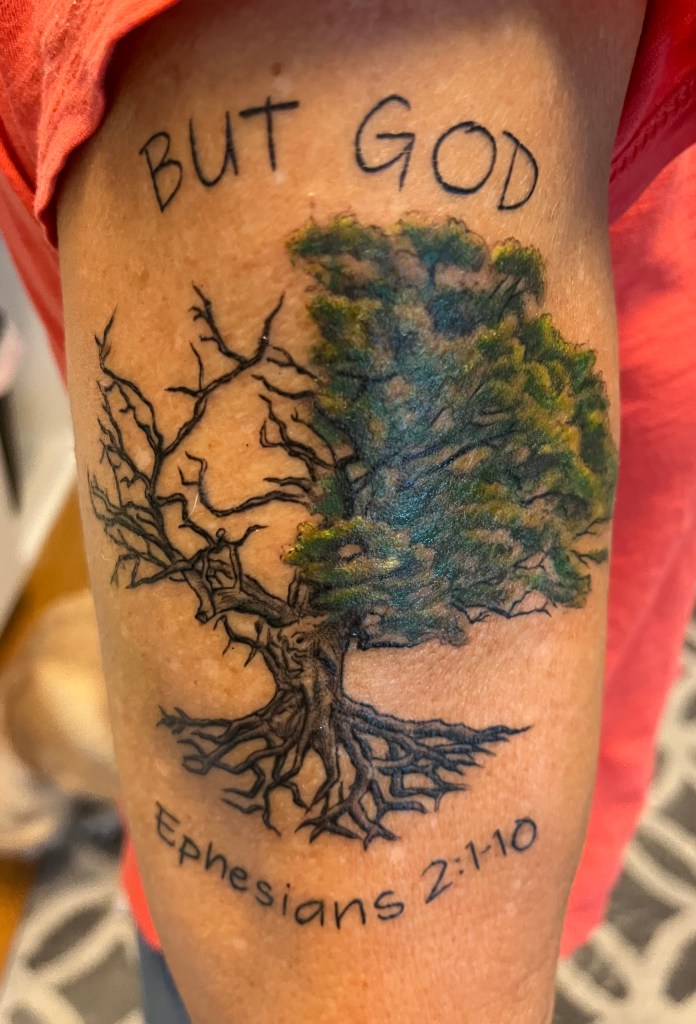
This prayer to God for reconciliation with Him will always be answered in one way: “Yes” (1 John 1:9). He has great love for you. He is rich in mercy. And He will take your brokenness, loneliness, pain, and deadness in sin to make you alive with Christ—not by doing anything, but by His grace (Ephesians 2:4-5).

So, if you or someone you know is feeling desperate, like whatever they do doesn’t matter because they don’t matter…share with them this incredible truth: They could never, ever, ever be “too much of a mess” or too far from God where Jesus won’t meet them with open arms and outstretched, nail-pierced hands. They just need to fall into His saving embrace.

Thank You, Lord, that we could never be too lost, too blind, or too broken to be too far from You. Please wrap Your loving arms around those today who are hurting and in need of Your peace.

no middle ground

The one who is not with Me is against Me; and the one who does not gather with Me scatters.  

Luke 11:23

Life is full of compromise and gray areas. In our families, at work, in the marketplace—we give a little, take a little, and typically do what it takes to make relationships and situations go smoothly. Generally speaking, this is a very good thing. Finding “middle ground” allows a group of people to effectively decide what laws to pass, how to proceed on a business deal, or where to go to dinner.

The average adult makes about 35,000 conscious decisions each and every day. Most are definitive and are within our sole prerogative. But thousands of these likely involve taking others needs and wants into consideration—hopefully. Christ followers, in particular, are called to act without selfish ambition or conceit, counting others more significant than ourselves and to look out for the interest of others (Philippians 2). Again, seeking the good of our neighbor (1 Corinthians 10:24) and loving others as Christ loves us (John 13:24), is a high calling that requires us to give up our desires and give in to others. So, navigating our days, weeks, months, and years is all about balancing “me” and “you” and “us”—walking in that middle ground in most things. (More of our society used to embrace this concept, and culture was so much more civil…oh, the good ol’ days of the early 2000s…)

All this being said, when it comes to the person of Jesus Christ, we actually hear this gray-area thinking a lot: “Jesus was a great teacher, but He wasn’t God.” (In fact, a Ligonier Ministries survey in 2020 found that one-third of professing evangelicals agreed that Jesus isn’t God.) People will say they admire Him and would like to live according to His teaching…when it fits in with their own wants and desires. Christians and non-Christians alike, pick and choose from God’s Word, constructing for themselves a Book of Compromise and Grayness. 

Although there are some theological themes from the Bible that are a bit “gray” and have been debated since the Church began two thousand years ago, these are all non-essentials to the Person and Work of Jesus Christ. God’s Word, dear friend, is black and white on the fact that Jesus is the Son of God. He came to earth fully God and fully Man to live a perfect life and die the death we deserve, paying the penalty for our sin. With His resurrection—which we celebrate this Sunday—He defeated Satan and death, giving us victory and exchanging our unrighteousness for His righteousness. He is the Way, the Truth, and the Life, and no one comes to the Father but through Him (John 14:6). 

In fact, through Jesus’ ministry, He asserted the Truth of who His is, why He lived, and why He died and rose again. So, to claim He was merely a “great teacher” is truly bizarre! He’d have to be a liar, delusional, or insane. (Why would you follow an insane teacher?)

What is the bottom line here? There is no middle ground with Jesus Christ. You are either for Him or against Him (Luke 11:23; Matthew 12:30). You either believe He is who He says He is and did what He said He’d do…or you don’t. You love Him or hate Him. You are His friend or His enemy. There’s a great verse from Joshua, as he’s talking with the Israelites (who were full of compromise on God’s instructions)—it’s one of those pillow-stitched and wall-décor verses, and it is a good one. The paraphrase is this: If it’s evil in your eyes to serve the Lord, choose this day whom you will serve (Joshua 24:15). So, friend, I’m asking you now, as Resurrection Day quickly approaches, to consider whom youwill choose. Which side are you on? There is no middle ground. Will you accept Jesus as your Lord and Savior or reject Him?

Father God, I pray that the Holy Spirit move within those who have not yet chosen to follow Jesus, that they move from either doubt or rejection to accepting the free gift of salvation.

rehearsing miracles

“When your children ask their fathers in time to come, saying, ‘What are these stones?’ then you shall inform your children, saying, ‘Israel crossed this Jordan on dry ground.’ For the Lord your God dried up the waters of the Jordan before you until you had crossed, just as the Lord your God had done to the Red Sea, which He dried up before us until we had crossed; that all the peoples of the earth may know that the hand of the Lord is mighty, so that you may fear the Lord your God forever.”

Joshua 4:21-24

After reading in Exodus about the dramatic and miraculous redemption of the Jewish people out of Egypt, you hit the next four books written by Moses: Exodus, Leviticus, Numbers, and Deuteronomy. Amid the laws and lists, there is the often-frustrating saga of the desert travels and how the Israelites so quickly forget the miracles (and very presence) of the Lord only to whine, gripe, and complain. We read how when they first got to the Promised Land’s border and 12 spies were sent to scope it all out, that 10 guys came back shaking in their sandals. Only Joshua and Caleb remembered that this was land promised to them by the Lord—so it already belonged to them. That’s when their 40-year wandering began, and that entire generation—except Joshua and Caleb—died in the desert as a consequence of their disobedience. 

So, I just love the first four chapters of the book of Joshua when it’s time for the next-gen 12 tribes to take what’s theirs under Joshua’s leadership (even though it’s sad that Moses can’t experience this particular victory). There’s a lot of depth to explore (cue the events with Rahab the harlot and the spies, for instance), but let’s focus on chapters 3 and 4. It’s time to cross over the Jordan River, and God ends the Israelites’ Exodus journey the same way He started it: by drying up a body of water so the people can walk through it to the other side. After everyone had safely crossed, the Lord told Joshua to set up 12 stones as a memorial of everything God had done for His people—from drying up the Red Sea to drying up the Jordan…and all the miracles in between. 

Why? So, when future generations asked, “What are these stones all about, Dad?” then they could be told and retold, “Because God miraculously rescued us!” The stones were there as a remembrance of the Lord’s miracles: delivering them out of slavery in Egypt (as the Egyptians handed over tons of gold and silver), feeding them food from heaven, quenching their thirst with water from a stone, never having their shoes wear out through 40 years of desert walking…and, of course, guiding them with His very presence by day and by night. (Again, so much to unpack there, but let’s get to the point du jour.)

What about you? Do you rehearse God’s miracles in your own life? Do you talk about, journal, or even set up monuments rehearsing all that the Lord has done for you? From our own redemption at the moment of salvation to provision to quenched thirst to God’s very presence in front of us and behind us…we all have a trail of miracles. Do we tell our friends, our children, our children’s children? Most importantly, do we remind ourselves of who God is—His grace, His mercy, His relentless faithfulness? If you haven’t made it a thing in your life, start today. Tell yourself and others of His Greatness, so “all the peoples of the earth may know that the hand of the LORD is mighty, so that you may fear the LORD your God forever” (Joshua 4:24).

Heavenly Father, thank You for the miracles all around us—from Your breath in our lungs to each sunrise to protection, health, provision. May we share the wonders of Your love with others…and remind ourselves of your faithfulness.